
Stop marketing to individuals when committees make the decision
A buying committee decision mapping workflow for marketers who are tired of no-decision losses


For every product marketer, personas and ICPs are foundational content that inform much of the content, sales plays, demand-gen programs, and enablement content. I’ve spent years building detailed personas, the kind with headshots, job titles, link-outs to LinkedIn profiles, goals, pain points, and objections neatly organized in a slide deck that looked great in a quarterly business review (QBR). At SAS, Dell, Alteryx, Alation, and now many of my clients, I’ve watched teams invest weeks refining these documents, convinced that if we could just describe the buyer precisely enough, the pipeline would follow.
Here’s what I’ve learned. Personas describe individuals. Groups make purchase decisions in B2B, and those groups are uncoordinated and messy.
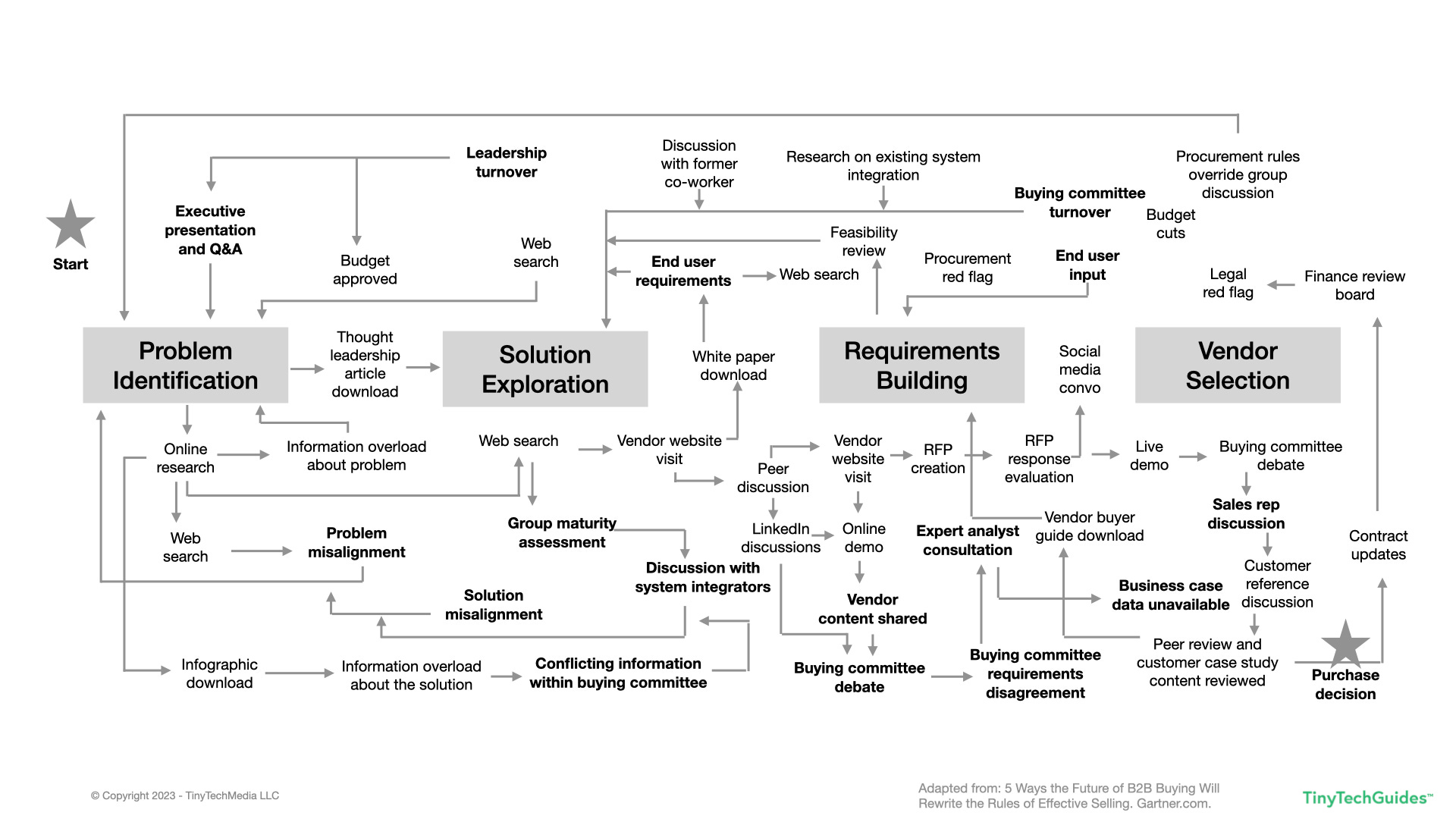
The belief that buying decisions are driven by individuals acting on clearly defined needs is one of the most persistent myths in B2B marketing. Entire marketing motions and demand-gen campaigns are built around it. Teams create a hypothetical buyer’s goals, segment them into top of funnel (TOFU), middle of funnel (MOFU), and bottom of funnel (BOFU), map their pain points, catalog their objections, and then build campaigns aimed squarely at that one profile. The problem with personas is that they are radically incomplete. They capture a slice of the picture and treat it like the whole thing.
In real B2B environments, decisions are rarely made by a single person optimizing for a single outcome. They are made by groups of people with overlapping authority, misaligned incentives, and very different definitions of risk. What looks like a straightforward purchase from the outside is, internally, a negotiation about tradeoffs, accountability, and exposure. This is why so many deals that appear healthy simply stall.
Why deals stall without a “no”
Most experienced marketers and sales leaders have encountered some version of the same pattern. The buyer is engaged, and the solution is aligned. The conversations are going well and are constructive. There is no explicit objection, no formal rejection, and no stated competitor win. And yet the deal fails to close. Isn’t “No competition” the most frequent “loss reason” in Salesforce? So why didn’t the deal close?
I watched this happen in many deals over my career. Every signal said “yes.” The champion was enthusiastic, the technical team had validated the solution, and leadership had even nodded along in the executive briefing. Then nothing happened. Weeks turned into months, and the deal just sat there, ghosted.
When deals stall like this, the post-mortem often defaults to surface explanations like budget cycles, shifting priorities, and internal delays. Those factors may be present, but they usually obscure something more fundamental. In Modern B2B Marketing, I cited Forrester’s B2B Buying Survey, which found that 60% of B2B purchases involve groups of four or more people, with committees of seven to ten members engaging in an average of 27 interactions across cycles that often exceed four months. With that many people, touchpoints, and months in play, the committee simply could not reach internal consensus without someone taking on unacceptable risk.
In these situations, no one wants to be the person who champions a decision that peers, superiors, or adjacent functions could later question. The safest option becomes inaction. The deal doesn’t die; it simply never resolves. What looks like indecision from the outside is usually self-preservation on the inside.
The limits of persona-based thinking
Traditional persona frameworks struggle to account for this reality because they assume coherence where none exists. They describe buyers as if priorities are stable, aligned, and internally consistent. In practice, those priorities are negotiated across roles with different incentives over a span of time that can last months or even years.
A CFO evaluating a purchase is often optimizing for predictability and downside protection. A functional leader may be optimizing for speed or performance. A technical stakeholder may be primarily concerned with long-term maintainability or security exposure. Each of these perspectives is rational, but they don’t naturally align. As I wrote in Modern B2B Marketing, every stakeholder involved in a B2B purchase must be convinced of three things: 1) that they have a need, 2) that the solution addresses it in a unique way, and 3) that they need it now. Getting seven to ten committee members to arrive at all three convictions simultaneously is where most deals break down.
When marketing speaks to “the buyer” as if these tensions don’t exist, it inadvertently creates content that fails to genuinely resonate with any member of the committee. Worse, it can amplify internal disagreement by validating one role’s priorities while ignoring another’s. The result is paralysis, and it’s almost invisible from the outside.
Why marketing needs to understand decision mechanics
This is where most teams fail. They treat buying committee dynamics as a sales problem, something to be solved at the deal stage. But by the time a buying committee is actively negotiating tradeoffs, many of the underlying narratives have already been set.
Marketing plays a critical role earlier in the process by shaping how problems are framed, how risk is understood, and what “good” decisions look like for the organization. When marketing fails to account for buying committee dynamics, the messaging may be directionally correct while completely missing how the decision actually gets made.
Strong thought leadership does more than persuade individuals. As I noted in Modern B2B Marketing, prospects consume five to seven pieces of content during their journey toward engaging with vendors, and many of those interactions happen outside the vendor’s website. When each committee member is independently consuming that much content with different concerns, aligning the group requires more than good messaging aimed at a single profile. Thought leadership helps groups align by providing a shared language for trade-offs and outcomes. That kind of alignment doesn’t happen by accident. It requires an explicit understanding of who is involved in decisions, how power is distributed, and where friction typically emerges. This is where persona-based thinking needs to give way to decision-based thinking.
From personas to decision reality
Instead of asking “Who is our buyer?” the more useful question is “What has to be true inside the organization for a decision to happen?” Answering that question requires mapping the buying committee as a system and treating it as an interconnected set of roles rather than a collection of isolated profiles. It means understanding authority alongside preferences, and surfacing the risks people are unwilling to own, along with the objections they’ll voice openly.
When teams do this work explicitly, the picture quickly changes. They see why certain messages resonate with some stakeholders and quietly alarm others. They understand why champions struggle to build momentum internally, even when they are personally convinced. And they gain visibility into the specific tensions that must be resolved for consensus to form. This clarity doesn’t guarantee a closed deal, but it does reduce the number of deals that drift into no-decision outcomes, and it gives marketing and sales a shared map for how to move a committee forward.
The buying committee decision mapping workflow
What follows is the full workflow used to make buying committee dynamics explicit and reusable. It builds on existing market, customer, and competitive insights to create a shared map of how decisions actually happen within target accounts. The workflow focuses on identifying who holds real authority, surfacing the unspoken risks that cause stalls, and translating those dynamics into content and messaging that help committees reach consensus rather than default to inaction.

Where this leads
I’ve watched teams spend months producing content that speaks eloquently to a buyer who doesn’t exist in isolation. The CFO reads it and worries about cost exposure, while the VP of Engineering reads it and worries about migration risk. The line-of-business leader reads it and wonders who will own the rollout, and everyone nods without moving forward.
Buying committees don’t need more content. They need help getting to a decision that everyone can live with, and that work starts with making the mechanics of the decision visible. Marketing is uniquely positioned to do it.
About David Sweenor
David Sweenor is the founder and host of the Data Faces podcast, where he talks with the people who are making data, analytics, AI, and marketing work in the real world. He is also the founder of TinyTechGuides and a recognized top 25 analytics thought leader and international speaker who specializes in practical business applications of artificial intelligence and advanced analytics.
With over 25 years of hands-on experience implementing AI and analytics solutions, David has supported organizations including Alation, Alteryx, TIBCO, SAS, IBM, Dell, and Quest. His work spans marketing leadership, analytics implementation, and specialized expertise in AI, machine learning, data science, IoT, and business intelligence. David holds several patents and consistently delivers insights that bridge technical capabilities with business value.
Books
Artificial Intelligence: An Executive Guide to Make AI Work for Your Business
Generative AI Business Applications: An Executive Guide with Real-Life Examples and Case Studies
The Generative AI Practitioner’s Guide: How to Apply LLM Patterns for Enterprise Applications
The CIO’s Guide to Adopting Generative AI: Five Keys to Success
Modern B2B Marketing: A Practitioner’s Guide to Marketing Excellence
The PMM’s Prompt Playbook: Mastering Generative AI for B2B Marketing Success
Follow David on Twitter@DavidSweenor and connect with him on LinkedIn.