

Listen now on YouTube | Spotify | Apple Podcasts
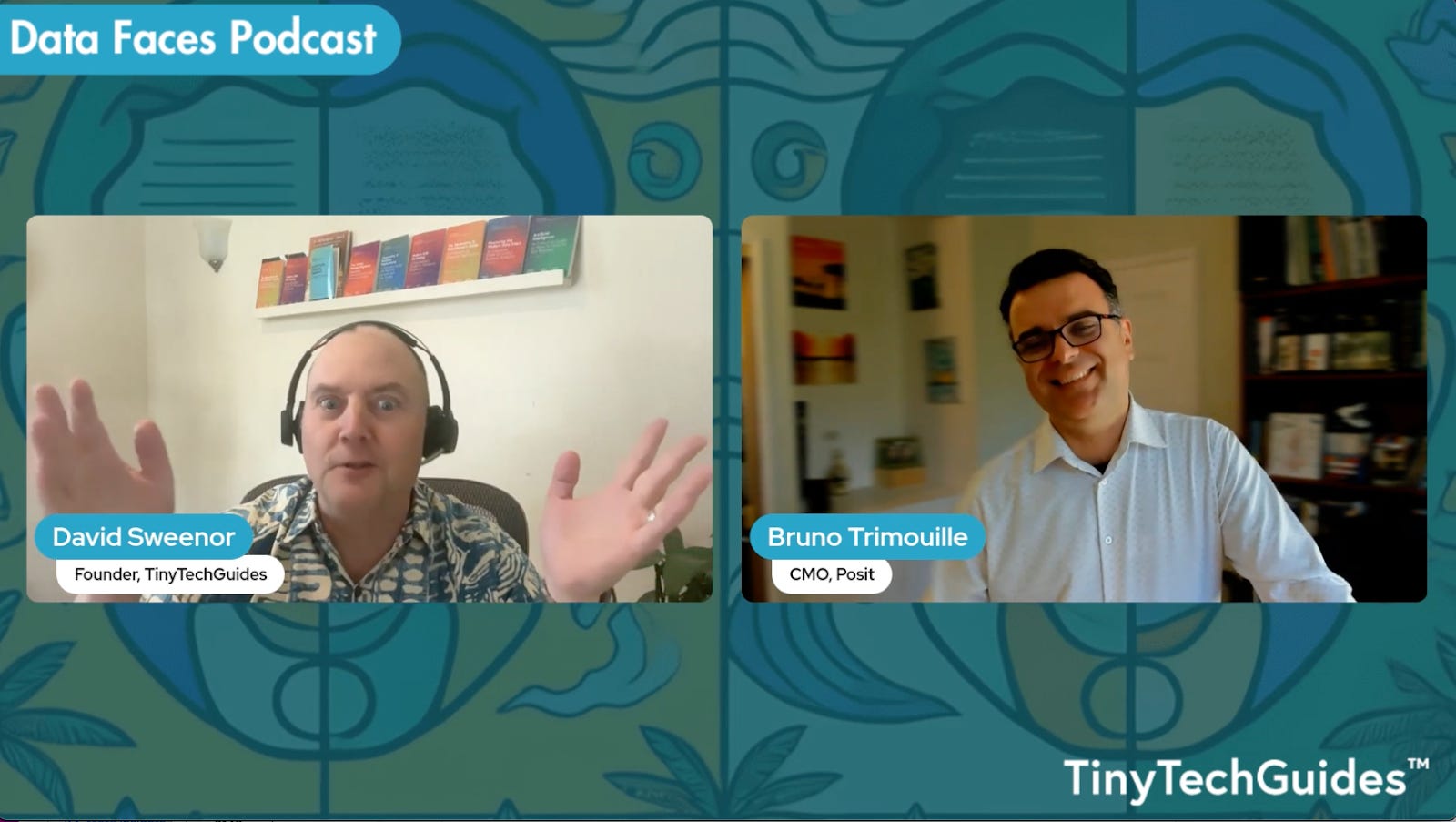
What happens when your organization makes a major decision based on analysis that no one can verify? The promise of AI-generated code and low-code tools is speed, but speed without trust is just faster failure. Bruno Trimouille, CMO at Posit, makes the case that trustworthy data science still requires code you can inspect and reproduce, and that AI, when used with the proper guardrails, can actually accelerate this approach rather than undermine it. In a recent conversation on the Data Faces Podcast, Bruno shared how Posit thinks about the tension between moving fast and maintaining trust, and how his own team applies these principles in practice.
About the speaker
Bruno Trimouille is the Chief Marketing Officer at Posit, the company formerly known as RStudio. Posit’s mission is to create open source software for data science, scientific research, and technical communication. Today, the company serves 10,000 customers, including 1,800 of the largest firms in regulated industries, and supports millions of users worldwide each week.
Why code-first still matters
Bruno Trimouille didn’t take the typical path to CMO. He started as a software engineer in France, moved through presales and consulting roles serving demanding customers across industries and geographies, and eventually landed in marketing because he saw it as the place where he could combine his technology background with his sales experience to amplify good messaging and storytelling. That engineering foundation shaped how he evaluates opportunities, and it’s what drew him to Posit in the first place.
What attracted Bruno wasn’t the marketing challenge. It was Posit’s foundational belief that trustworthy data science requires code you can question, validate, and repeat. He points to the work of John Chambers, creator of the S language that preceded R, who argued that reliable software must be verifiable and trustworthy. For Bruno, this principle translates directly into how data science should work.
“For software to be reliable, things need to be verifiable, and things need to be trustworthy. So for us, it means that the concept of data science being inspectable and reproducible, thus trustworthy, is paramount.”
— Bruno Trimouille, CMO at Posit
Low-code tools offer convenience, and they’ve helped more people access data science capabilities. But when those tools don’t do what you need, you’re stuck. Code-first isn’t about gatekeeping or making things more complicated for business users. It’s about creating outputs that someone else can examine, challenge, and rerun to confirm the results hold up.
AI as the bridge, not the replacement
Bruno sees the same tension play out in nearly every customer conversation. Data scientists want speed. They want to access data quickly, model it, and share outcomes with business stakeholders before the moment passes. Business stakeholders want speed, too, because the whole point of data science is to make faster, better decisions. And somewhere in the middle sits IT, charged with imposing governance on a process everyone else wants to accelerate.
For years, this tension created a divide. Code-first tools served developers well but felt inaccessible to business users. Low-code platforms promised analytics democratization, but that promise has largely failed to launch. Neither approach served both groups particularly well.
Bruno believes AI is starting to dissolve this standoff, not by replacing code-first approaches, but by making them faster and more accessible.
“AI sort of creates a middle ground approach, which is still code-first based. It bridges the gap, especially when it comes to speed and quick turnaround time, and brings this code-first approach much closer to business stakeholders.”
— Bruno Trimouille, CMO at Posit
The key distinction Bruno draws is between AI that generates black-box outputs and AI that generates artifacts you can actually examine. Posit recently unveiled a set of AI-driven capabilities, and the team is deliberate about calling their approach “responsible AI.” For Bruno, that phrase isn’t marketing language. It means ensuring that everything AI generates is a piece of code, a SQL query, or another technical artifact that can be inspected and rerun for reproducibility.
AI governance isn’t about slowing AI adoption or treating it with suspicion. It’s about recognizing that speed without governance creates liability, while governance designed correctly doesn’t have to slow anyone down.
The three-layer model for scalable, responsible data science
When asked about the common complaint that governance slows things down, Bruno offers a direct rebuttal. He doesn’t see innovation and governance as competing forces. He sees them as two sides of the same coin.
“This is not a zero-sum game between innovation and governance, but rather a framework where governance enables innovation.”
— Bruno Trimouille, CMO at Posit
Bruno describes Posit’s approach as three layers that build on each other, moving from the inside out.
Layer one: Centralized, secure data foundation
Data science starts with data, and security, lineage, and access control at the platform level are non-negotiable. This is why Posit partners with companies like Amazon, Databricks, and Snowflake, because governance at the data layer has to be airtight before anything else can work.
Layer two: Code-first workflow
This layer goes beyond just the model to encompass the entire process of building it. The workflow needs to be repeatable, transparent, and well-documented. Bruno is emphatic on this point, noting that transparency is “really non-negotiable” for many use cases and customers, particularly those in regulated industries.
Layer three: Agile deployment and real-time feedback
When data scientists can instantly deploy models and expose them to business stakeholders, feedback happens in real time rather than weeks later. Stakeholders can interact with the output, run scenarios, and respond while the context is still fresh. As Bruno puts it, “Things can happen in real time, and that pretty much unlocks things.”
The FDA as a proof point
The FDA now accepts clinical trial submissions in open source formats, a significant shift for such a heavily regulated agency. Bruno calls this “a really quantum step by a very established and very governed agency to look at that as new pathways.” He notes that the shift also addresses a practical talent challenge, as skills in legacy, proprietary tools are becoming harder to find. Open source lets these organizations tap into a broader talent pool while maintaining the transparency and reproducibility that regulators require.
From models to mission-critical applications
Data science outputs at Posit’s customers aren’t just models feeding dashboards or reports that sit in someone’s inbox. They’re interactive applications where business stakeholders engage directly with the analysis to make consequential decisions. Bruno describes a spectrum of “data-driven assets” that organizations are building, ranging from APIs that let other systems call models programmatically to scheduled reports with embedded insights to fully interactive applications.
The NASA example stands out.
“If you look at an institution like NASA, they have interactive applications where they look at their staffing needs, staffing prediction for really complex missions like going back to Mars—and interactively play different scenarios, drill into the data, do what-if analysis, and really interact with the data to drive better decisions.”
— Bruno Trimouille, CMO at Posit
What connects these examples is that business stakeholders aren’t waiting for a PDF summary or a static slide deck. They’re working directly with data science outputs, exploring scenarios and stress-testing assumptions to inform real commitments of resources and time. That direct interaction depends on trust, which is precisely why Bruno keeps returning to the code-first foundation.
Practicing what we preach: AI in Posit’s own marketing
Posit sells the philosophy of responsible, inspectable, code-first data science to its customers. But does the company practice what it preaches internally? Bruno’s marketing team offers a valuable test case.
Bruno describes his own evolution with AI as a series of distinct phases. Early on, he saw it as a productivity tool to eliminate “blank page syndrome.” That was valuable, but it was just the starting point.
“I really saw AI as a fantastic tool at the beginning to remove the blank page syndrome... But then I really saw the power that this could deliver in not just being a bot sitting next to you, but literally a thinking partner.”
— Bruno Trimouille, CMO at Posit
As a thinking partner, AI has transformed how Bruno approaches market research. He describes having “market studies on tap,” with the ability to customize research to data science within a specific industry, examining trends and opportunities in ways that would have taken weeks with traditional methods.
On the campaign side, Posit has experimented with mass personalization that maintains clear guardrails. Rather than letting AI write emails from scratch, the team uses templates with defined placeholders that AI can customize based on persona, use case, and industry. Bruno has seen conversion rates of 10 to 12 percent on targeted segments of previously dormant leads. The AI reawakened them through personalization, but within a governed structure.
Throughout these applications, Bruno emphasizes that preserving authentic voice remains essential. As he puts it, “I wouldn’t advocate to have AI generate something, and you press the publish button, and it goes.” The pattern mirrors what Posit advocates for data science more broadly. AI generates, humans inspect.
The hybrid skill set for what comes next
Bruno’s career path from software engineering through presales and consulting to CMO illustrates the hybrid profile he believes will define the next generation of data-driven leaders. He isn’t theorizing about what works. He’s living it.
When asked what skills will matter most going forward, Bruno starts with curiosity. Not curiosity as an abstract value, but curiosity as a practice. He experiments with tools like NotebookLM to turn written documents into audio learning content, recognizing that different people absorb information in various ways.
“Marketing has become a greater mix between the art and the creative stuff, but science and data. You need to have a more hybrid skill set. Think about AI as a thinking partner.”
— Bruno Trimouille, CMO at Posit
Bruno also points to cross-functional collaboration as essential rather than a nice-to-have. He now partners regularly with Posit’s data science team to develop market and data insights, a partnership that simply didn’t exist five years ago. Marketing as a discipline has become what he calls “a team sport,” and the teams you need to play with keep expanding.
There’s also a systems dimension to leadership that Bruno emphasizes. He thinks of his marketing stack as an architecture to ensure tools are connected and data flows smoothly. Leaders who treat their technology as a collection of disconnected point solutions will struggle compared to those who design for integration.
Bruno closes with an observation that applies well beyond marketing.
“Having raving fans beats all kinds of marketing campaigns you can put together.”
— Bruno Trimouille, CMO at Posit
The lesson for data science leaders is the same. Build trust with your stakeholders through transparency and reliability, and you earn credibility that no dashboard or presentation alone can deliver. The code-first philosophy Bruno advocates isn’t just about technical rigor. It’s about building the kind of credibility where people believe what you show them because you’ve never given them a reason not to.
Listen to the full conversation with Bruno Trimouille on the Data Faces Podcast.
Based on insights from Bruno Trimouille, Chief Marketing Officer at Posit, featured on the Data Faces Podcast.
Podcast Highlights - Key Takeaways from the Conversation
0:52] Bruno introduces Posit, its rebrand from RStudio, and the company’s mission to create open source software for data science, scientific research, and technical communication.
[2:06] Bruno shares his unconventional path to CMO, starting as a software engineer in France and moving through presales and consulting before landing in marketing.
[4:53] The case for code-first data science: Bruno explains how John Chambers’ principle that reliable software must be verifiable shaped Posit’s foundational philosophy.
[7:32] Speed meets governance: Bruno describes the tension between data scientists wanting velocity and IT demanding control, and how responsible AI can bridge that gap.
[9:13] The three-layer model: Bruno outlines Posit’s framework for scalable data science, from secure data foundations to code-first workflows to real-time deployment and feedback.
[11:29] From models to mission-critical apps: Bruno shares how NASA uses interactive applications for staffing predictions on Mars missions, running what-if scenarios in real time.
[15:53] The FDA’s “quantum step”: Bruno discusses how the FDA now accepts clinical trial submissions in open source formats, and why this matters for talent and transparency.
[18:09] Community as strategic moat: Bruno explains why he had to shift his mindset from seeing community as a marketing channel to treating it as an extension of the team.
[21:31] AI as thinking partner: Bruno describes his evolution from using AI to fix “blank page syndrome” to having “market studies on tap” for strategic research.
[24:04] Mass personalization with guardrails: Bruno shares how AI-driven email customization achieved 10-12% conversion rates on dormant leads while maintaining governed templates.
[34:04] The hybrid skill set: Bruno on why curiosity, cross-functional collaboration, and systems thinking define the next generation of data-driven leaders.
About David Sweenor
David Sweenor is an expert in AI, generative AI, and product marketing. He brings this expertise to the forefront as the founder of TinyTechGuides and host of the Data Faces podcast. A recognized top 25 analytics thought leader and international speaker, David specializes in practical business applications of artificial intelligence and advanced analytics.
Books
Artificial Intelligence: An Executive Guide to Make AI Work for Your Business
Generative AI Business Applications: An Executive Guide with Real-Life Examples and Case Studies
The Generative AI Practitioner’s Guide: How to Apply LLM Patterns for Enterprise Applications
The CIO’s Guide to Adopting Generative AI: Five Keys to Success
Modern B2B Marketing: A Practitioner’s Guide to Marketing Excellence
The PMM’s Prompt Playbook: Mastering Generative AI for B2B Marketing Success
With over 25 years of hands-on experience implementing AI and analytics solutions, David has supported organizations including Alation, Alteryx, TIBCO, SAS, IBM, Dell, and Quest. His work spans marketing leadership, analytics implementation, and specialized expertise in AI, machine learning, data science, IoT, and business intelligence.
David holds several patents and consistently delivers insights that bridge technical capabilities with business value.
Follow David on Twitter@DavidSweenor and connect with him on LinkedIn.


