

Listen now on YouTube | Spotify | Apple Podcasts
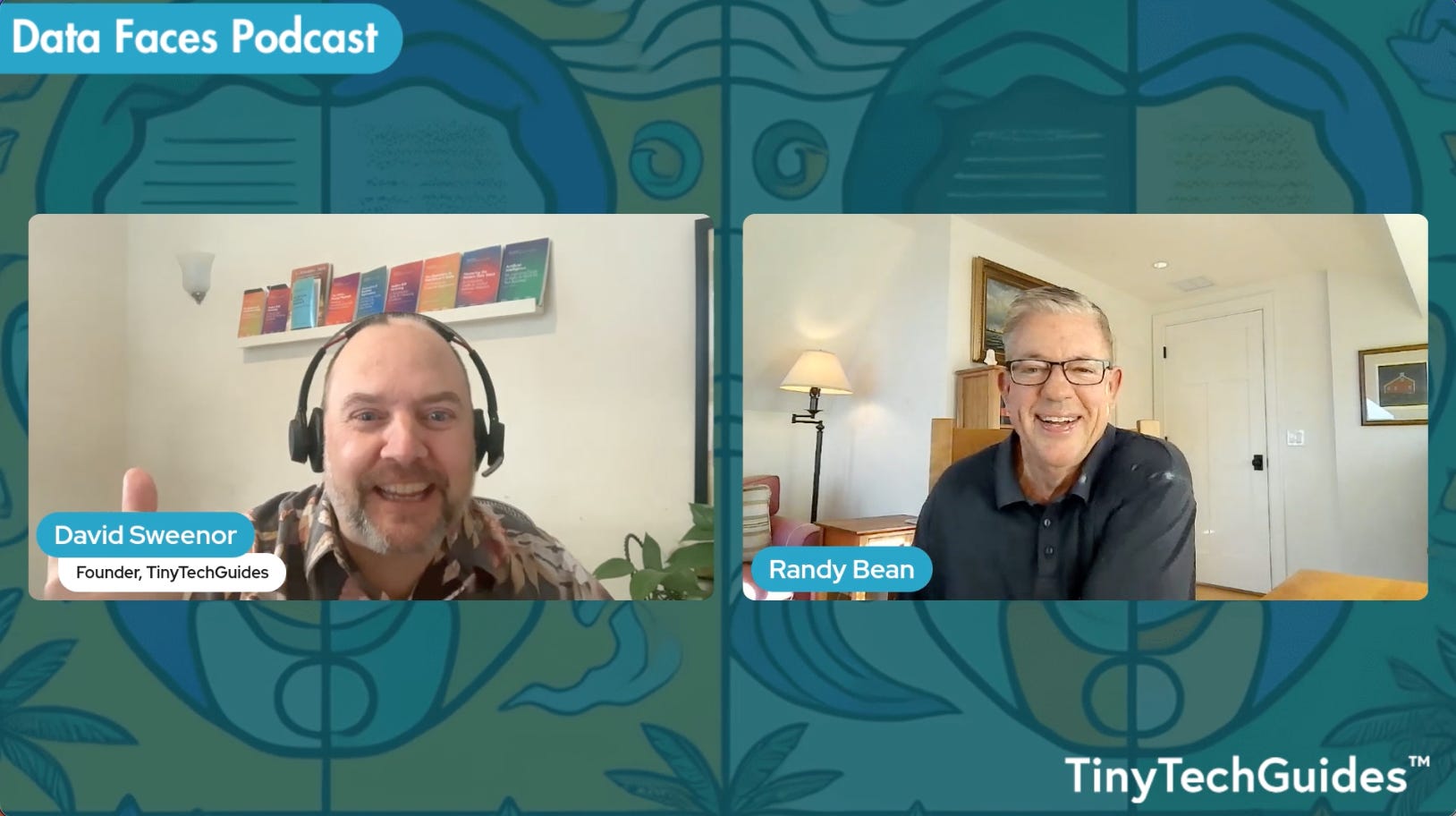
Randy Bean has spent four and a half decades watching organizations struggle with data. The tools keep getting better, faster, and cheaper. Yet companies keep failing for the same reasons they failed in 1988 when Randy was working on natural language processing (NLP).
The failures result from barriers that are both cultural and structural. Leaders remain reluctant to ask uncomfortable questions about organizational readiness, and C-suites have fragmented into competing data roles with overlapping mandates.
In his 2026 AI and Data Leadership Executive Benchmark Survey, Randy found that 94 percent of Fortune 1000 executives cite culture and people as their principal barrier to AI adoption, while only 6 percent point to technology. This gap explains why so many AI projects never make it past the pilot stage.
About the speaker
Randy Bean is a senior advisor and board member who has spent 4.5 decades working with executives at Fortune 1000 companies on data, analytics, and AI leadership. He founded and leads the annual AI and Data Leadership Executive Benchmark Survey, now in its 15th year, which captures insights from over 100 Chief Data Officers, Chief AI Officers, and Chief Analytics Officers from the Fortune 1000. His work has been published in Forbes, Harvard Business Review, MIT Sloan Management Review, and the Wall Street Journal.
In this episode, we discuss
Why 94 percent of AI challenges are cultural rather than technical
The “readiness test” that predicts whether organizations will succeed or stall
Why legacy companies should stop benchmarking against digital disruptors
The case for unifying CDO, CAO, and CAIO roles
Why the best Chief Data Officers aren’t data geeks
The 5-question, 5 percent framework that kills “boil the ocean” projects
The 94 percent problem hiding in plain sight
Randy didn’t set out to become a data expert. He studied English, History, and Art History in school. But when he needed a job, employers wanted technical skills, so he trained as a COBOL and assembler programmer. His interest was never really in the programming itself, but in the stuff you moved around, the data.
That background gave Randy a different lens than most technologists. Where others frame AI adoption as an engineering problem, he keeps coming back to the human side. People never really like to change on their own volition, and organizations are made up of people, which compounds the issue.
The 2026 survey data confirms this. When asked to identify the principal challenge to data and AI adoption, 94 percent of Fortune 1000 executives pointed to culture and people. Only 6 percent said technology was the barrier. This ratio has held steady for years. The technology has transformed dramatically. The human barriers haven’t.
Cultural barriers persist because they’re difficult to measure. You can audit a tech stack and benchmark infrastructure against competitors. But how do you assess whether an organization is genuinely ready to change how it operates?
Randy has developed his own informal test. He described folding up his notebook ten minutes into specific client meetings, sitting through the rest, already knowing the engagement wouldn’t go anywhere.
“They weren’t ready. You could tell it. They said, ‘We’ve got everything all figured out.’”
— Randy Bean, Senior Advisor and Board Member
When leaders claim they have everything figured out, they signal they’re not open to the difficult conversations transformation requires. Better tooling won’t fix that.
The challenge for data and AI leaders is learning to recognize these signals early, before investing months in initiatives that were never going to succeed.
Get your house in order
During the pandemic, the Chief Digital Officer of the nation’s largest insurance company shared something striking with Randy. “We’ve done more to execute on our digital transformation strategy in the past six months than we did in the previous 20 years.” The company moved because it had to. Customers couldn’t meet face-to-face, and online channels became existential overnight.
Transformation at legacy companies rarely happens because of vision or strategy. It happens when the alternative becomes untenable.
Randy’s survey data reveals an important distinction. Ninety percent of Fortune 1000 companies are legacy organizations. Only 10 percent belong to the “move fast and break things” crowd.
“90% of the Fortune 1000 are legacy companies... Those 10%, they can pioneer new things, but for the other 90%, they don’t need to compete against that other 10%—they just need to compete against one another.”
— Randy Bean, Senior Advisor and Board Member
When a 150-year-old manufacturer compares its AI maturity to a Silicon Valley startup, it creates false pressure that leads to poorly planned initiatives and wasted resources. The bank that figures out AI-driven fraud detection doesn’t need to outpace Google. It needs to outpace the other banks.
Stop measuring your AI maturity against tech-native outliers. Your real competition is the traditional competitor who figures out cultural readiness before you do.
Competitive pressure isn’t the only problem. There’s a structural one too. The proliferation of data-related C-suite titles has created confusion at many organizations. Randy’s 2026 survey found that 39 percent of companies have appointed a Chief AI Officer in addition to their existing Chief Data Officer. This leads to competing functions, unclear accountability, and redundant mandates.
In December 2025, Randy co-authored an article in Harvard Business Review with Vipin Gopal and Tom Davenport, arguing for a unified Chief Data, Analytics, and AI Officer role. About 30 percent of readers pushed back with legitimate concerns about the differences between AI and data governance operating models.
“We were just trying to create some level of sanity and clarity in the C-suite, so that you didn’t have all these competing and redundant functions, but rather came up with a unified mindset around how you manage data, analytics, and AI.”
— Randy Bean, Senior Advisor and Board Member
The point isn’t that unification is the only answer. The fact is that fragmentation has costs. Someone needs to be accountable for how data, analytics, and AI work together.
Hire for business acumen, not technical pedigree
The Chief Data Officer at JP Morgan Chase sits on the bank’s 14-person operating committee and reports directly to Jamie Dimon. Her previous role wasn’t in data engineering or analytics architecture. She was the Global Chief Investment Officer. Her questions focus on the most complex business problems the bank needs to solve and how data and AI can address them.
Diana Schulthaus, Chief Data Officer at Colgate-Palmolive, offered another perspective at a panel Randy moderated. When asked how much time she spends on offensive versus defensive data activities, her answer surprised the room. “I spend 100% of my time on offense.” The audience applauded.
In 2020, only 55 percent of organizations reported focusing on offensive, growth-oriented data activities. By 2025, that number jumped to 86 percent. The role has evolved from regulatory compliance to business strategy.
“You don’t need a data architect or data engineer or data modeler to be the chief data officer. You need a business leader who understands how data is going to be used so the organization can be more effective.”
— Randy Bean, Senior Advisor and Board Member
Randy learned this lesson early in his career. As a young COBOL programmer, he watched his technical colleagues return from meetings with business users and complain that the business people were stupid and couldn’t articulate what they wanted.
One day, he pushed back.
“They’re the people that employ us. They’re the people that go out and get the customers. They’re the people that do the business. We wouldn’t even be employed if it wasn’t for these people. So maybe we should give them some credit and figure out how to speak their language.”
— Randy Bean, Senior Advisor and Board Member
Effective data leaders understand enough about technology to separate nonsense from reality, but they lead with business problems rather than technical architecture.
The 5-question, 5 percent framework
Early in Randy’s career, he worked at a major bank that was part of Bank of America. He noticed the organization captured enormous amounts of customer information. One day, he asked a manager what they did with all of it.
“The regulators make us hold on to it for six years,” the manager said, “and then we put it in the furnace.”
The data existed. The infrastructure to store it existed. But nobody had asked what questions the data could answer.
He’s watched too many companies since then pursue what he calls the “boil the ocean” approach, trying to perfect every piece of data across the enterprise before putting any of it to use.
“Understand what the most important business questions that you need to ask are—not like 1,000, but like 5 or 10... Not all data is created equal, and sometimes 5% of the data is all that it takes to answer 95% of the questions.”
— Randy Bean, Senior Advisor and Board Member
Start with the five to ten most important business questions your organization needs to answer. Then identify the key data elements required to answer those specific questions. Resist the urge to build a comprehensive data infrastructure before you’ve proven value on the questions that matter most.
The same discipline applies to AI adoption timelines, and Randy encourages leaders to resist FOMO and the pressure to match competitors’ announcement cycles.
“Forget about the FOMO, the fear of missing out. Step back a little and think about where we’re going as a business. Where do we need to be? What capabilities do we need to have? How can AI augment those capabilities?”
— Randy Bean, Senior Advisor and Board Member
In 2023, only 5 percent of organizations had AI in production at scale. By 2024, that jumped to 24 percent. By 2025, it reached 40 percent. Progress came from organizations that planned thoughtfully, not from those that rushed to keep up with headlines.
What matters is where you end up in three, five, or ten years. Not what you announce this quarter.
Leading from the middle
Not every reader holds a CDO title or sits in the C-suite. Many data and AI practitioners work within organizations where leadership hasn’t embraced these shifts. They see the 94 percent problem from the inside but lack the authority to mandate change.
The notebook test works at every level. When your leadership team says they have everything figured out, you’re facing a readiness gap. More analysis or better dashboards won’t change the minds of those who aren’t open to change.
The 5-question framework scales both up and down. You don’t need enterprise-wide buy-in to prove value. Find one business question your team can answer with existing data. Deliver insight that helps someone make a better decision. Build from there.
“It does help to have some level of underpinnings so that you can separate the nonsensical from the realities... You gotta know enough to call BS when someone’s giving you a pitch.”
— Randy Bean, Senior Advisor and Board Member
Progress in AI adoption hasn’t come from organizations that moved fastest. It came from those who built readiness, clarified accountability, and focused on questions that mattered. That work can start anywhere in the org chart.
Call to action
Randy Bean’s full 2025 AI and Data Leadership Executive Benchmark Survey is available at randybeandata.com, along with nearly 300 articles published in Forbes, Harvard Business Review, MIT Sloan Management Review, and the Wall Street Journal.
Your organization probably has the right technology. The more complicated question is whether your culture and leadership structure will let you use it.
Listen to the full conversation with Randy Bean on the Data Faces Podcast.
Based on insights from Randy Bean, Senior Advisor and Board Member, featured on the Data Faces Podcast.
Podcast Highlights - Key Takeaways from the Conversation
Podcast highlights
0:53 — Randy shares his unexpected path into data, starting with degrees in English, History, and Art History before training as a COBOL programmer.
1:23 — The “furnace” story: Randy asks a bank manager what they do with customer data and learns they hold it for six years then destroy it.
2:42 — Randy describes flying to Microsoft the same afternoon he was called, walking into a room with Steve Ballmer.
3:55 — Origin of the AI and Data Leadership Survey: a JP Morgan CIO in 2012 asked Randy to survey Fortune 1000 executives on big data.
5:19 — CDO role evolution: from 12% adoption in 2012 to 90% in 2025, and from 28% saying the role was successful in 2020 to 70% today.
8:04 — Diana Schulthaus from Colgate-Palmolive: “I spend 100% of my time on offense.”
10:51 — The 94/6 split: 94% of executives cite culture and people as the principal barrier to AI adoption, only 6% cite technology.
10:51 — Legacy company math: 90% of Fortune 1000 are legacy firms who only need to compete against each other, not the “move fast and break things” 10%.
12:15 — Pandemic transformation: “We’ve done more in six months than in the previous 20 years.”
14:22 — AI at scale progression: 5% in 2023, 24% in 2024, 40% in 2025.
14:22 — “Forget about the FOMO... step back and think about where are we going as a business.”
21:43 — Randy’s HBR article advocating for a unified Chief Data, Analytics, and AI Officer sparked fierce debate with 70% agreement and 30% thoughtful pushback.
21:43 — JP Morgan Chase’s CDO sits on the 14-person operating committee, reports to Jamie Dimon, and was previously the Global Chief Investment Officer.
25:30 — The COBOL programmer lesson: “They’re the people that employ us... maybe we should give them some credit and figure out how to speak their language.”
27:59 — Randy biases “hugely towards an understanding of the business” when selecting data leaders, but notes technical grounding helps you “separate the nonsensical from the realities.”
29:02 — “You gotta know enough to call BS when someone’s giving you a pitch.”
30:27 — The 5-question, 5% framework: “Not all data is created equal, and sometimes 5% of the data is all that it takes to answer 95% of the questions.”
31:44 — The notebook test: Randy describes folding up his notebook ten minutes into meetings when organizations say “we’ve got everything all figured out.”
34:08 — Where to find Randy’s work: randybeandata.com with nearly 300 articles from Forbes, HBR, MIT Sloan Review, and Wall Street Journal.
About David Sweenor
David Sweenor is an expert in AI, generative AI, and product marketing. He brings this expertise to the forefront as the founder of TinyTechGuides and host of the Data Faces podcast. A recognized top 25 analytics thought leader and international speaker, David specializes in practical business applications of artificial intelligence and advanced analytics.
Books
Artificial Intelligence: An Executive Guide to Make AI Work for Your Business
Generative AI Business Applications: An Executive Guide with Real-Life Examples and Case Studies
The Generative AI Practitioner’s Guide: How to Apply LLM Patterns for Enterprise Applications
The CIO’s Guide to Adopting Generative AI: Five Keys to Success
Modern B2B Marketing: A Practitioner’s Guide to Marketing Excellence
The PMM’s Prompt Playbook: Mastering Generative AI for B2B Marketing Success
With over 25 years of hands-on experience implementing AI and analytics solutions, David has supported organizations including Alation, Alteryx, TIBCO, SAS, IBM, Dell, and Quest. His work spans marketing leadership, analytics implementation, and specialized expertise in AI, machine learning, data science, IoT, and business intelligence.
David holds several patents and consistently delivers insights that bridge technical capabilities with business value.
Follow David on Twitter@DavidSweenor and connect with him on LinkedIn.


