

Listen now on YouTube | Spotify | Apple Podcasts
After years of pilots, proofs of concept, and bold promises about transformation, 2026 is shaping up to be the year when AI investments face real scrutiny. Valuations are wobbling, executives want to see returns, and most organizations still can’t measure whether their AI initiatives are actually working.
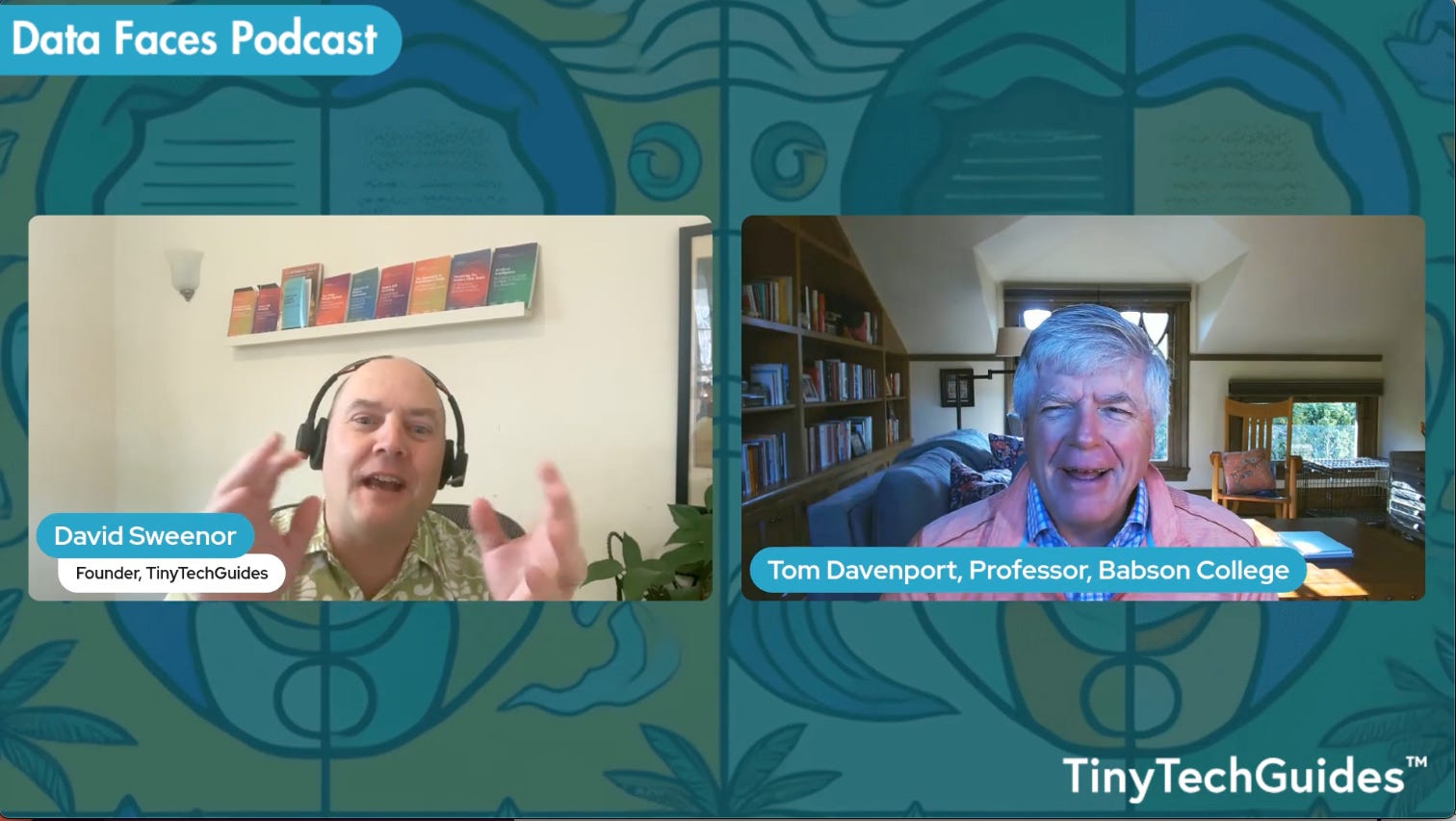
Tom Davenport has watched this pattern before. He’s seen technologies overpromise, watched companies chase hype rather than value, and studied what separates the organizations that deliver real results from those that don’t. His message for the year ahead is direct: the quest for value is the biggest thing, and most companies aren’t yet set up to capture it.
About the speaker
Thomas Davenport is a Distinguished Professor at Babson College and one of the most respected voices in analytics and AI. He has spent decades helping leaders turn data and technology into real business value, from coining the term “business process reengineering” to authoring the influential Competing on Analytics. His research and teaching have shaped how companies think about AI, automation, and the evolving impact of generative AI.
In this conversation, we discuss:
Why we’re in an AI bubble and what that means for enterprise leaders
The shift from “broad and shallow” pilots to “deep and narrow” implementations
Why boring transactional use cases will deliver value before transformational ones
What the P&G experiment with 776 people reveals about disciplined AI experimentation
The “work slop” problem and why 80% of generative AI output never gets reviewed
How to build the organizational discipline that separates AI success from theater
The value gap AI needs to close in 2026
“I do think we’re in a bubble,” Tom says. “And I think there’s a lot of real value to AI, of course, but I think the valuations of some of the companies are somewhat crazy.”
Generative AI has attracted a disproportionate share of attention, in part because it’s so accessible. Anyone can use ChatGPT, and anyone can form an opinion about it. That accessibility has inflated expectations beyond what the technology currently delivers. “I think because it’s so accessible to the public and to the chattering classes, if you will, people who write stuff and do podcasts, it’s gotten way more attention than it deserves in the overall kind of pantheon of AI,” he explains.
The market is starting to recalibrate. “We’re starting to see some cracks in the valuations of some of these companies, and suggestions that maybe we don’t need a data center on every corner by a nuclear power plant next door.”
At the organizational level, a different version of the same problem is playing out. Most companies have taken a “broad and shallow” approach to AI adoption, encouraging employees to experiment with tools like ChatGPT for individual productivity. Tom recently co-authored a Harvard Business Review article with Stanford researchers on the need to shift from individual-level use to enterprise-level implementation. The diagnosis resonated; shortly after, another HBR piece appeared with a blunt title: “Stop Running So Many AI Pilots.”
Broad and shallow adoption makes measurement nearly impossible. One company Tom spoke with has essentially given up on proving productivity gains from individual AI tools and now positions them as an employee satisfaction and retention benefit. It’s a candid admission that the value case remains unproven.
“It’s too hard to measure either the productivity or the quality of output, and hardly anybody does measure it.” — Thomas Davenport, Distinguished Professor, Babson College
Start with transactional, not transformational
When asked about the “killer use case” for agentic AI, Tom’s answer catches most people off guard. “Hold on to your hat,” he says with a hint of sarcasm. “Accounts Payable work.”
Keynote speakers don’t get standing ovations for invoice processing, but that’s precisely why it works. The companies making real progress with AI aren’t chasing moonshots. They’re targeting processes that are repetitive, measurable, and low risk. “Generative AI is quite good at sucking the important data out of invoices and sending a message to some other agent,” he explains.
“That’s not exciting, but it is transactional. And I think a lot of people have not terribly exciting jobs, looking at invoices coming in and extracting the key components.” — Thomas Davenport, Distinguished Professor, Babson College
Trust remains a sticking point even in these straightforward applications. Companies aren’t yet comfortable letting AI agents handle complete workflows autonomously. “In a lot of cases, people don’t trust typical agents, so they send it to Stripe or something that they do trust, actually, to pay it when the time comes.” A pattern is emerging: AI handles extraction and routing; established systems handle execution.
The timeline for agentic AI to mature is longer than many expect. Tom estimates “closer to five years before we have real transactional applications,” more optimistic than Andrej Karpathy’s recent prediction of a decade but still far from imminent. For now, companies are “trying to do things that are not terribly risky or important to see how it goes.”
There’s a human dimension here, too. The workers processing invoices don’t have glamorous jobs, but they represent fundamental roles that AI can meaningfully improve. The opportunity isn’t to eliminate these workers overnight but to free them from the most tedious parts of their jobs.
Customer intent is the emerging opportunity
Accounts payable won’t transform a company’s growth trajectory. But customer-facing functions might.
Tom is working with researchers from Cambridge University on a project examining call center interactions. Their early data points to an underappreciated reality: many service calls are actually sales opportunities in disguise.
Service representatives weren’t hired to sell. They were hired to solve problems and answer questions politely. “The people who do that work are generally there because they can answer nicely customer questions about service, and they’re not very good at selling,” Tom notes. The opportunity outpaces the skills of the people handling the calls.
Generative AI could bridge that gap by detecting customer intent in real time. Rather than expecting service reps to suddenly become salespeople, organizations could use AI to identify when a conversation represents a sales opportunity and route it to the right resource.
“In many cases, calls that come into a call center or contact center are not just about service. In many cases, they are often opportunities to sell those customers more.” — Thomas Davenport, Distinguished Professor, Babson College
The implementation Tom envisions involves a channel that “makes sense of what the customers want, and either sends it to another bot that can do that thing, or sends it to a human that can do that thing.” Traditional boundaries between marketing, sales, customer service, and customer success would blur, unified by a shared focus on understanding and responding to what customers actually need. This research is still early, but it suggests where enterprise AI might deliver its next wave of measurable value.
Experimentation is the discipline that separates success from theater
If one thing distinguishes companies capturing real value from AI, it’s their willingness to run rigorous experiments. Tom identifies “disciplined experimentation” as one of the essential capabilities for generative AI success, and he’s blunt about how rare it is.
The example he returns to is Procter & Gamble. He recently spoke with the head of data science and AI at P&G about an experiment they conducted in new product development, designed to answer a straightforward question: Does generative AI actually help people come up with better ideas?
They tested 776 people and carefully measured the results. “Individuals with generative AI were more productive than teams without generative AI,” Tom reports, “and they came up with a better balance of sort of commercial and innovation-oriented ideas.”
What makes this example stand out isn’t just the findings. P&G tested their hypothesis rigorously and published the results with academic collaborators. “Some vendors do it. Anthropic has tested a few things. But in general, companies don’t do that disciplined experimentation,” he says.
“The key thing is that they tested it and ended up writing a paper about it with a bunch of academics. That just doesn’t happen very often.” — Thomas Davenport, Distinguished Professor, Babson College
Most organizations skip this step entirely. They deploy AI tools, encourage adoption, and assume value is being created without any structured way to verify it. AI initiatives are everywhere, with no reliable way to tell which ones are working.
AI work slop is flooding the enterprise
Even when AI delivers useful output, organizations face a stubbornly difficult challenge. A new term has emerged to describe it: “work slop.”
Work slop is the low-quality content that floods organizations when people accept AI outputs without review or refinement. Tom cites a McKinsey study suggesting that 80% of generative AI output is never reviewed. People create the content but never evaluate whether it’s accurate, relevant, or good.
Fixing this requires substantial behavior change. “People have to learn how to get rid of that work slop and edit the output and add some value to the output of generative AI,” Tom says.
He sees the challenge firsthand in his teaching. “I find it really challenging to do with my students, because people seek the easiest way to do something, and we’re not necessarily all trained to be effective editors of content, rather than producers of good first drafts.” Evaluating and improving AI-generated content requires skills different from those needed to create content from scratch, and most people haven’t developed them.
Some of his students have been candid about the tradeoff. They told him, “It was easier to just paraphrase a Wikipedia article” than to iterate on AI outputs, check sources, and add original thinking. That shortcut mentality is understandable, but it undermines the potential value AI could deliver.
“We’re not necessarily all trained to be effective editors of content, rather than producers of good first drafts.” — Thomas Davenport, Distinguished Professor, Babson College
His approach in the classroom offers a model for organizations. “Show me all the prompts you tried,” he tells students. “Show me the edits that you made to the output. Check the sources.” Without that discipline, AI becomes a machine for producing mediocre content at scale.
The path forward
Tom’s perspective on AI in 2026 isn’t pessimistic, but it is grounded in decades of watching technology hype cycles come and go.
“AI can really transform the process of thinking about how you do your work,” he says. That transformation won’t come from deploying more tools or running more pilots. It requires examining workflows, designing experiments, measuring outcomes, and building new habits around how people interact with AI-generated content.
The iterative mindset matters too. “Never take the first output,” he advises. “Iterate on it, ask for alternative interpretations.” Most people accept the first response as definitive when it should be treated as a starting point.
“Doing things the right way is never easy. I guess that’s the lesson here.” — Thomas Davenport, Distinguished Professor, Babson College
The organizations that capture value from AI in 2026 won’t be the ones with the most advanced models or the largest infrastructure investments. They’ll be the ones willing to go deep rather than broad, to measure what matters, and to build the organizational muscle to turn raw AI output into something worth using.
The companies that keep running shallow pilots while waiting for AI to magically deliver value will find themselves in the same place a year from now, still waiting. The ones that do the work won’t have to.
Listen to the full conversation with Tom Davenport on the Data Faces Podcast.
Based on insights from Thomas Davenport, Distinguished Professor, Babson College, featured on the Data Faces Podcast.

Podcast Highlights - Key Takeaways from the Conversation
[2:09] What’s real and what’s hype in AI heading into 2026
[4:24] Why Tom believes we’re in an AI bubble and what needs to come down to earth
[5:51] The unsexy “killer use case” for agentic AI: Accounts Payable
[7:26] Why Tom calls generative AI “predictive analytics on LSD” and his case for the term “analytical AI”
[9:15] The shift from individual-level AI usage to enterprise-level implementations
[11:21] How customer-facing functions represent the next frontier for AI value
[13:26] The disciplines that separate generative AI success from failure
[14:44] Inside the P&G experiment: how 776 people tested whether AI improves ideation
[15:45] The “work slop” problem and why 80% of AI output never gets reviewed
[17:33] Why every prediction about AI and jobs has been wrong
[22:20] How Tom teaches students to use AI the right way: “Show me your prompts, show me your edits”
[24:53] The de-skilling risk: when Tom’s doctor got caught using AI
[30:58] Why business process re-engineering is making a comeback, enabled by AI
About David Sweenor
David Sweenor is an expert in AI, generative AI, and product marketing. He brings this expertise to the forefront as the founder of TinyTechGuides and host of the Data Faces podcast. A recognized top 25 analytics thought leader and international speaker, David specializes in practical business applications of artificial intelligence and advanced analytics.
Books
Artificial Intelligence: An Executive Guide to Make AI Work for Your Business
Generative AI Business Applications: An Executive Guide with Real-Life Examples and Case Studies
The Generative AI Practitioner’s Guide: How to Apply LLM Patterns for Enterprise Applications
The CIO’s Guide to Adopting Generative AI: Five Keys to Success
Modern B2B Marketing: A Practitioner’s Guide to Marketing Excellence
The PMM’s Prompt Playbook: Mastering Generative AI for B2B Marketing Success
With over 25 years of hands-on experience implementing AI and analytics solutions, David has supported organizations including Alation, Alteryx, TIBCO, SAS, IBM, Dell, and Quest. His work spans marketing leadership, analytics implementation, and specialized expertise in AI, machine learning, data science, IoT, and business intelligence.
David holds several patents and consistently delivers insights that bridge technical capabilities with business value.
Follow David on Twitter@DavidSweenor and connect with him onLinkedIn.


