

Listen now on YouTube | Spotify | Apple Podcasts
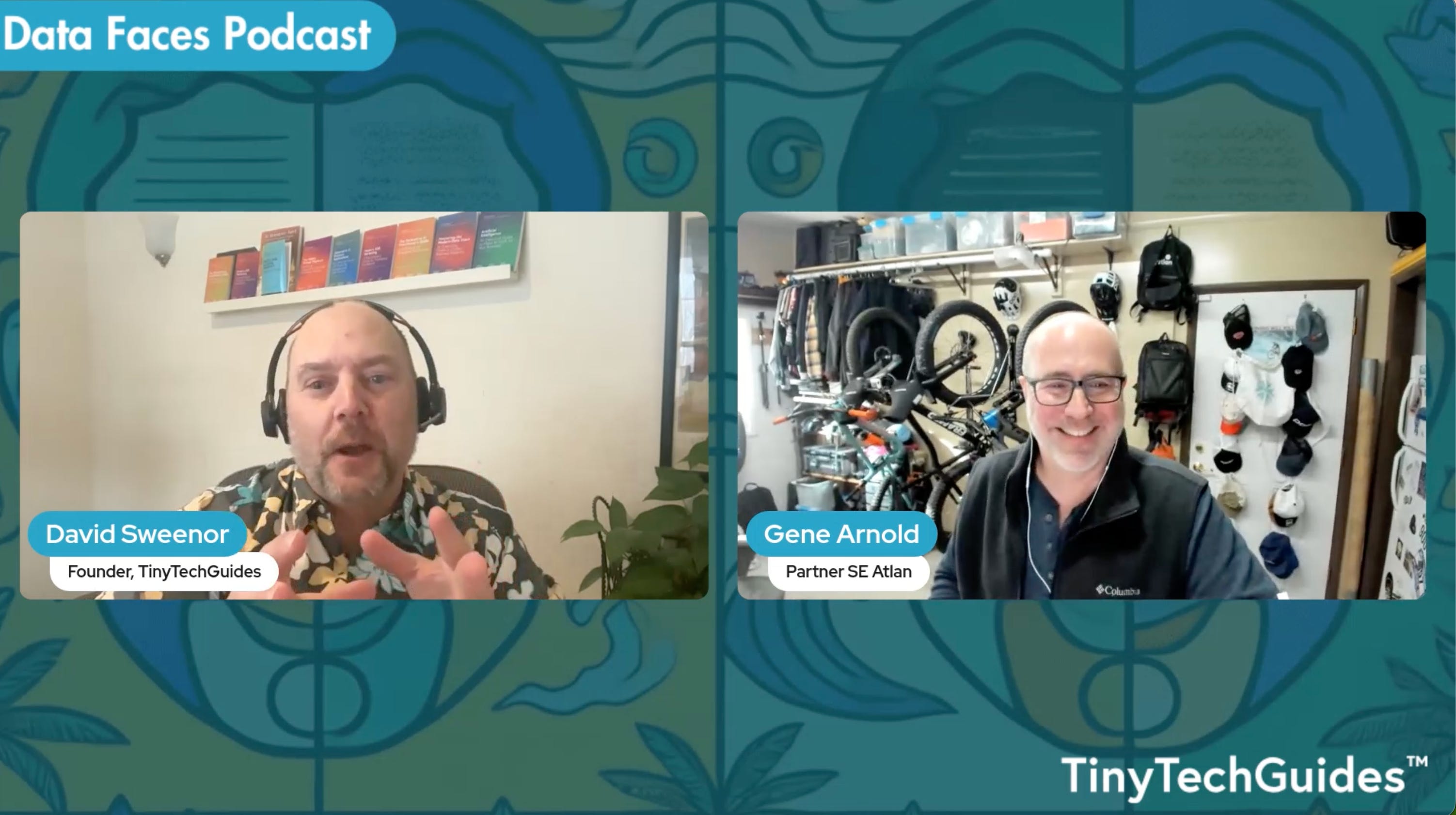
Gene Arnold has never been more excited about a technology in his career, which is exactly why he’s become an active voice for pragmatic governance. Gene works as a partner sales engineer at Atlan, where he came to AI through the data catalog world and discovered that models living on top of data made governance unavoidable.
But his perspective extends beyond enterprise software. He runs a GitHub AI agent engineering course, builds with 3D printers and stepper motors, creates his own semantic generators, and hosts a YouTube channel on mountain biking that taught him how social media lets practitioners break into industries without turning pro. Gene sees governance as the foundation that lets good ideas reach production.
About the guest
Gene Arnold is a partner sales engineer at Atlan, where he works closely with partners like Snowflake and Databricks to help organizations navigate governance, modern data stacks, and AI use cases. In this conversation, we discuss:
Why the people most excited about AI often care most about governance
How pressure from leadership and individual contributors creates gaps
Why models persist bias rather than create it
The role metadata and semantic layers play in AI accuracy
How to pick your first AI project and what to watch for
The dual pressure problem
When Gene talks with organizations about AI adoption, he sees the same recurring pattern. Pressure to move fast comes from leadership and individual contributors alike, and most companies have no framework for managing what gets built.
From the top, leadership sees competitors moving and asks why the organization isn’t keeping pace. AI isn’t a hard concept to grasp when everyone’s talking to ChatGPT. Executives don’t need technical depth to feel the strategic urgency. As Gene put it, “Top down, I don’t have to be a rocket scientist to understand we need it.”
From the bottom, individual contributors can now build AI tools without knowing how to code. Gene pointed to how quickly someone can knock out a workflow with tools like n8n, with templates available for almost everything. “Bottom up, I don’t have to be a rocket scientist to build something.”
That collision is where governance breaks down. Gene described the pattern he sees repeatedly: “Look what I made. Look what I made. Okay, hey, whoa, they made it. Send it out. Whoa, stop.” Roughly 80% of AI projects never reach production. Organizations are building plenty, but the challenge is building things that survive scrutiny.
“We don’t want to stop innovation. That’s a bad thing. But here’s the box. Let’s try to stay somewhere in the box.” — Gene Arnold, Partner Sales Engineer, Atlan
The box is a container for evaluating ideas before they hit production. Two accountability questions expose most governance gaps before they become public failures. First, do we have the right to do this? Gene cited an example of an organization that used facial recognition without proper authority to include faces in its models. The technology worked fine, but the authorization didn’t exist, and legal exposure followed. Second, what did we train it on? Traceability and lineage matter because models inherit whatever lives in the training data, including the biases and foibles that data contains.
Organizations that skip governance early often end up locking down AI entirely after a public failure. A little structure now prevents overcorrection later.
Models don’t create bias, they persist it
Even organizations that answer both accountability questions correctly at launch can find themselves exposed months later. Governance requires ongoing attention beyond the initial launch.
“A model doesn’t create bias. A model simply persists bias. The model was trained on X. If X was biased, then the model is biased.” — Gene Arnold, Partner Sales Engineer, Atlan
By now, the case of resume screening models that have passed over qualified female candidates is well-documented. Models trained on historical hiring data learned to predict what companies had historically done, including decades of biased evaluation. The teams involved may have done proper diligence, and the model performed exactly as designed. That was the problem.
Gene’s takeaway is direct: “I can’t train a model on the future. I don’t know what the future holds. I have no data on the future.” History carries black marks, and models trained on history inherit them.
The challenge gets harder when one variable masks another. Gene described research he conducted on AI bias using loan approval data. A model might show that PhD holders get approved at higher rates than those with bachelor’s degrees, which seems reasonable until you remove the PhD variable, and a different pattern emerges. The PhD status was masking discrimination based on other factors, like zip code. As Gene explained, “Sometimes one feature in the model can outweigh something else, and all of a sudden, when that one’s turned off... the PhD covered the fact that down here, loan payment wasn’t always paid in full.”
The answer is continuous testing. Gene recommended running tests against thousands of synthetic records, varying demographic features to see if outcomes shift unexpectedly. The goal isn’t perfection. “Constant testing, tweaking the levers to make sure that you properly, at least make it as unbiased as you can.”
Humans also need to remain part of the decision chain. You “can’t just flip the switch and say, best of luck, and let this thing go all day long and hope that you get it right. That’s scary.”
Governance starts with knowing what you have
Bias isn’t the only blind spot. Many organizations don’t know what data they have, which makes governance impossible before the model is even built.
Gene sees this play out in a simple scenario. Ask a model for “a summary of East Coast Q1 sales.” The model doesn’t know what Q1 means to your organization. Does your fiscal year start in January? What territories count as the East Coast? Without semantic information, the model guesses based on patterns in historical queries or fails entirely.
“Metadata is literally the deciding factor on how a model answers correctly.” — Gene Arnold, Partner Sales Engineer, Atlan
“If you don’t give it that semantic knowledge, it doesn’t know how to answer some of these questions,” Gene explained. This extends to any company-specific metric. How does the organization calculate customer lifetime value? What counts as an active user? The model needs that context, and the context needs to be governed.
The problem compounds when organizations have multiple versions of the same information floating around. Gene described scenarios where 10 versions of the same manual exist across different systems. Which one should train the model? Without proper curation through a data catalog or similar system, you’re building on uncertain foundations.
His practical workaround acknowledges reality: “What I can do now with AI is feed all 10 of those versions into a model, and now ask it questions... and it’ll respond well, based on the knowledge that I have, these are the three different methods that I feel would be appropriate, and that’s where the human judgment comes in.”
Start with what already works
Gene’s advice for getting started runs counter to the instinct to use AI to fix broken processes. “Pick a process that you know is working well, but you want to automate. Unless you know what good looks like, how do you know if the model is doing well?”
“Automation can either make things really good really fast, or make things really bad really fast.” — Gene Arnold, Partner Sales Engineer, Atlan
The reasoning is straightforward. If you don’t know what correct output looks like, you can’t evaluate whether the model is helping or hurting.
Gene distinguished between processes that just need speed and processes that need complete rethinking. “There are times where, well, you know what, we needed someone to read all these files. We still think they need to be read, but I’m going to have a model run them now. The process is fine, but the model can read it faster than a human.” Document summarization, internal search across knowledge bases, and data quality checks, which use predefined rules, all fit this pattern.
The opposite scenario requires more caution. “There are other times, like the Excel spreadsheet, where we’re going to say, well, now’s a good time to bring in a new system, right? And retool.” Customer-facing agents, automated decision-making on loans or hiring, and any process where the existing approach is broken are poor candidates for a first AI project.
Before any project goes live, leaders should be able to answer a handful of questions. Who owns this model? Who trained it and on what data? What does correct output look like? Do we have the rights to use this data in this way? What’s our plan for ongoing monitoring?
Gene noted that the first project teaches more than the use case itself. “You’re going to learn if your team works well together, is your AI governance workflow proper, right? So you’re going to learn a ton by just picking that one project that you already know how it’s supposed to end.”
One win builds trust, and trust enables the next project. Governance creates the conditions for that first win to happen safely.
Build something beautiful with it
Throughout our conversation, Gene kept returning to the same idea: governance exists to protect your ability to keep building. His philosophy on AI comes down to a simple metaphor.
“AI is just like any other tool. I can take a hammer and I can build something beautiful with it, or I could take that hammer, and I could smash something beautiful.” — Gene Arnold, Partner Sales Engineer, Atlan
For data science leaders, the challenge has shifted from whether to adopt AI to whether you can sustain it without creating problems that force you to backtrack later. The organizations that keep momentum will be the ones that built governance into the process from the start.
Gene’s parting point: “AI is not going away... this is the time where you’ve got the chance, because AI is still pretty new, to embrace it, understand what it can do and build something beautiful with it.”
Listen to the full conversation with Gene Arnold on the Data Faces Podcast.
Based on insights from Gene Arnold, Partner Sales Engineer at Atlan, featured on the Data Faces Podcast.
Podcast Highlights - Key Takeaways from the Conversation
Podcast highlights
[1:10] Gene’s path from DJ to AI advocate Gene explains how he accidentally fell into sales engineering after years as a DJ and discovered it was “a nerd’s stage to present and have fun.” His work at Atlan with data catalogs led him into AI, which he calls his “new love and passion.”
[7:05] How data governance and AI governance relate Data governance focuses on keeping data clean, accurate, and unbiased. AI governance focuses on decision-making and how systems behave. Gene explains how the two work together: “It’s an agent. Let’s govern what it’s allowed to do and how, and then when it does it, what data is it actually going to respond back?”
[9:56] Why unstructured data is the gold mine Gene argues that 80% of valuable information lives in emails, documents, and support conversations. “That’s where your answers are. That’s where your conversations are.” Smart companies are extracting insights from customer support chat logs to understand what products are working and what’s failing.
[12:28] The duplicate data problem Most organizations have multiple versions of the same information scattered across systems. Gene’s practical workaround: feed all 10 versions into a model and let it surface the best approaches, then bring in human judgment to make the final call.
[14:34] Why 80% of AI projects never reach production “It’s just so easy to make something. But then when you really put it down into the real world and run it, did you really properly QA this new cool thing?” Gene argues that companies are failing because they lack governance workflows to evaluate what’s being built.
[17:10] The dual pressure problem AI pressure comes from leadership and individual contributors simultaneously. “Top down, I don’t have to be a rocket scientist to understand we need it. Bottom up, I don’t have to be a rocket scientist to build something.” This creates a collision that governance needs to manage.
[19:18] The resume screening bias example Gene walks through the well-known case of AI models penalizing feminine-coded language in resumes. “A model doesn’t create bias. A model simply persists bias. The model was trained on X. If X was biased, then the model is biased.”
[21:40] The two accountability questions Gene identifies the questions that expose governance gaps: Who designed the model? What did you train it on? He also cites an example where an organization used facial recognition without proper authority to use the faces in their models.
[23:56] How one variable can mask another Gene describes his research on AI bias using loan approval data. PhD holders got approved at higher rates, but when you removed that variable, discrimination based on zip code emerged. “Sometimes one feature in the model can outweigh something else.”
[27:02] Start with a process you know is working “Pick a process that you know is working well but you want to automate. Unless you know what good looks like, how do you know if the model is doing well?” Gene advises against using AI to fix broken processes as a first project.
[28:15] Automation amplifies everything “Automation can either make things really good really fast, or make things really bad really fast.” Gene explains that your first project teaches you more than just the use case: you learn if your team works well together and if your governance workflow is functioning.
[31:29] Why metadata is the deciding factor Gene introduces the semantic layer concept: models need context to answer questions correctly. Without knowing what “Q1” means to your organization, a model will guess or fail entirely. “Metadata is literally the deciding factor on how a model answers correctly.”
[36:10] Gene’s parting advice “AI is just like any other tool. I can take a hammer and I can build something beautiful with it, or I could take that hammer and smash something that was beautiful.” Gene encourages listeners to embrace AI while understanding its weaknesses so it gets used correctly.
About David Sweenor
David Sweenor is an expert in AI, generative AI, and product marketing. He brings this expertise to the forefront as the founder of TinyTechGuides and host of the Data Faces podcast. A recognized top 25 analytics thought leader and international speaker, David specializes in practical business applications of artificial intelligence and advanced analytics.
Books
Artificial Intelligence: An Executive Guide to Make AI Work for Your Business
Generative AI Business Applications: An Executive Guide with Real-Life Examples and Case Studies
The Generative AI Practitioner’s Guide: How to Apply LLM Patterns for Enterprise Applications
The CIO’s Guide to Adopting Generative AI: Five Keys to Success
Modern B2B Marketing: A Practitioner’s Guide to Marketing Excellence
The PMM’s Prompt Playbook: Mastering Generative AI for B2B Marketing Success
With over 25 years of hands-on experience implementing AI and analytics solutions, David has supported organizations including Alation, Alteryx, TIBCO, SAS, IBM, Dell, and Quest. His work spans marketing leadership, analytics implementation, and specialized expertise in AI, machine learning, data science, IoT, and business intelligence.
David holds several patents and consistently delivers insights that bridge technical capabilities with business value.
Follow David on Twitter@DavidSweenor and connect with him onLinkedIn.


